Hail damage
Signs of roof hail damage, and how to tell if you have it
Hail damage is the most consequential thing that can happen to a North Texas roof and the hardest to see. It frequently leaves the roof watertight while cutting years off its life — which is why it is missed, and why it gets argued about.
Written and reviewed by Finley L., Texas Roofing Now
·
Signs of roof hail damage
The signs, in the order you are most likely to encounter them:
- Granules collecting in the gutters or at the base of downspouts. The most common early indicator, and visible without leaving the ground.
- Dark, bruised spots on the shingle surface where granules have been knocked away, exposing the darker mat underneath.
- Soft spots that give slightly under thumb pressure — the mat has been damaged beneath an apparently intact surface. Often easier to feel than to see.
- Fractured or cracked mats, sometimes with cracks radiating from the impact point.
- Dents in soft metals — vents, turbines, gutters, downspouts, air-conditioning condenser fins, mailboxes, fence caps.
- Torn or dimpled window screens.
- Damage that is random and scattered, not in lines, rows or a pattern following the roof geometry.
- Damage concentrated on the elevations facing the direction the storm came from.
What hail damage actually looks like
Below is an illustration rather than a photograph — and we want to be direct about why. This site is a referral service, not a roofer, so there are no inspections of our own to photograph, and we are not going to caption stock imagery as though it were our work. What we can do is show you accurately what the three defects look like and explain what each one means.
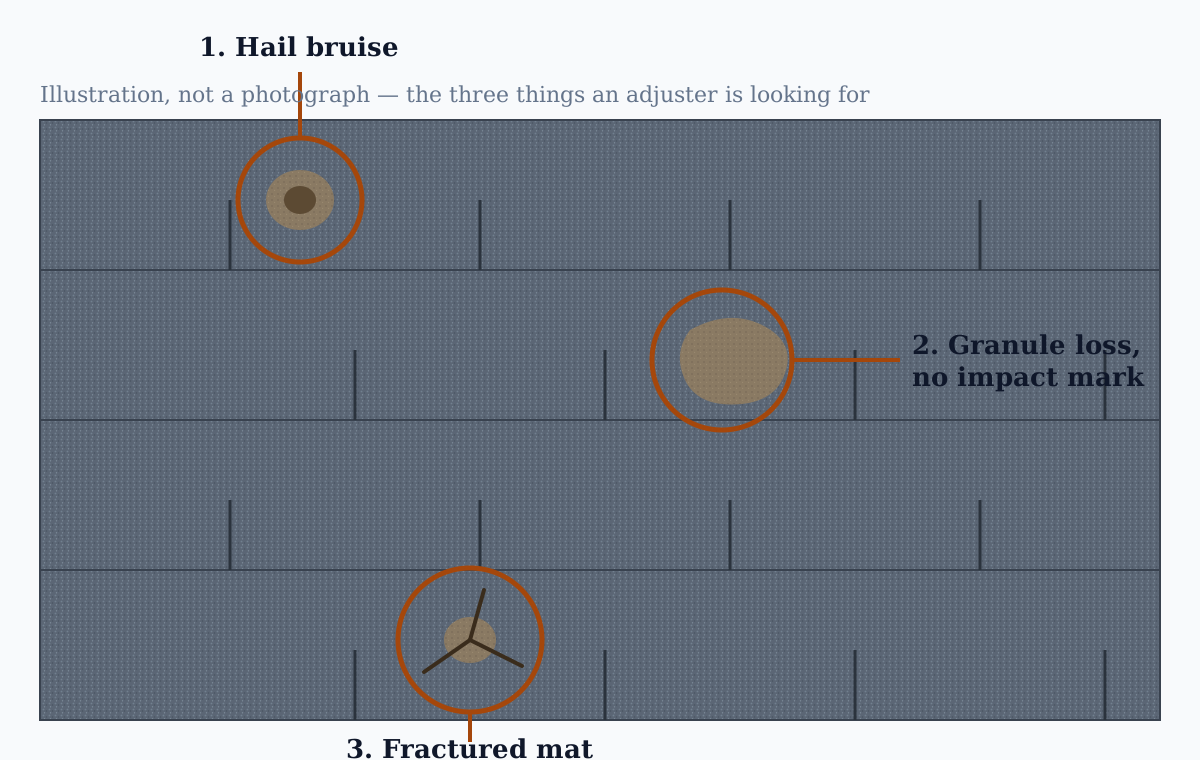
1. The bruise
A circular area where the impact has knocked granules away and compressed or damaged the mat beneath. It may be a slightly different color, it may look almost normal, and it will often feel soft — like pressing a bruise on fruit. This is the classic hail signature and the one most often missed from the ground, from a drone, and by anyone in a hurry.
2. Granule loss without a visible impact mark
Granules are not decoration. They shield the asphalt mat from ultraviolet light, and once they are gone the mat degrades. A patch of exposed mat is real damage even with no dent, because the shingle's remaining service life has been shortened.
This is also why granule accumulation in the gutters is worth taking seriously. A small amount of loss is normal, especially on a new roof shedding manufacturing excess. A noticeable accumulation after a hail storm is not.
3. The fractured mat
The most severe of the three: the impact has cracked the mat itself, sometimes with cracks radiating out from the point of impact. The shingle's structural integrity is gone at that point, and water penetration is now a question of time.
How to tell if your roof has hail damage
Following this order gives you a real answer rather than a guess, and keeps you off a roof you should not be on.
- Check the gutters and downspouts from the ground. Look for granule accumulation, especially at downspout outlets.
- Check the soft metals. Gutters, downspouts, vents, the fins on your air-conditioning condenser, mailbox, fence caps. Dents here mean hail of some size hit your property.
- Check the window screens for tears and dimpling.
- Walk the perimeter looking for shingle pieces and for anything visible on the slopes from ground level.
- Check the attic for daylight through the decking, staining or damp.
- Note the storm date and direction if you know them.
- Get someone on the roof. Steps one to six establish whether it is worth looking. They do not diagnose the roof. Bruising in particular requires hands on the shingle.
What gets mistaken for hail damage
Half of assessing hail damage is ruling out things that look like it. These are the usual suspects:
- Blistering. Small raised bumps caused by moisture escaping the asphalt. Blisters are raised and often pop, leaving a small crater that can look like an impact mark. They are a manufacturing or ventilation issue, not storm damage.
- Normal granule loss from age. Uniform across the slope and heaviest on the sun-exposed elevations, rather than random and scattered.
- Mechanical damage. Foot traffic, an antenna installation, a satellite dish, someone's ladder. It follows a path or clusters around a fixture.
- Manufacturing defects. Usually consistent and repeating across the product rather than random.
- Algae and lichen staining. Cosmetic dark streaking, common in humid conditions, not damage.
- Tree and debris damage. Real damage, sometimes covered, but not hail — it is concentrated under the overhanging branch rather than scattered.
The reason this matters: a claim filed for damage that turns out to be blistering or ordinary wear is a claim that gets denied, and the denial letter can make a later, legitimate claim harder work.
What an adjuster is actually assessing
Adjusters are looking for a coherent story rather than a single dramatic photograph. In practice they are checking:
- Pattern. Is the damage random and scattered, as impact is, or does it follow the roof's geometry, as wear does?
- Directionality. Is it concentrated on the elevations facing where the storm came from?
- Corroboration. Do the soft metals, screens, fences and other surfaces agree that hail hit this property?
- Severity. Is the mat damaged, or is this cosmetic surface scuffing? This is usually where a claim turns.
- Density. How many impacts within a test area — many insurers assess hail using a marked test square on each slope.
- Age and condition. A roof already in poor condition complicates everything. TDI notes that a roof in poor condition might not be covered at all.
TDI recommends being present for the adjuster's inspection, and this list is why. An adjuster covering many properties after a widespread event will not necessarily find damage nobody points out. Going in with a documented report turns that visit into a walkthrough of a written list.
How big does hail have to be?
There is no single threshold, and we are not going to give you one, because the honest answer is that it depends on more variables than a number can carry: hail size, density and shape, the speed and angle of the wind driving it, the age and condition of the shingle, and the material.
Small hail driven hard into an aged, brittle roof can cause real damage. Larger hail falling with little wind onto a new laminated shingle may cause none. Hail reports and radar-derived hail maps are useful supporting context for a claim — they are not a substitute for assessing the actual roof.
For the same reason, we do not publish hail statistics for individual North Texas suburbs. The National Weather Service's regional statement is that “Large hail, damaging winds, flooding, and tornadoes occur nearly every year in the Dallas/Fort Worth Metroplex.” — true of the metroplex, and not evidence about your street.
Why a damaged roof may not leak
This is the single most common reason hail damage goes unaddressed until it is too late to claim.
Hail damage is mostly damage to the shingle's protective layer. Knock the granules off and the mat is exposed to ultraviolet light; bruise the mat and its structure is compromised. Neither creates a hole. The roof keeps water out, sometimes for years, while the material degrades faster than it should.
By the time it does leak, two things have usually happened: the damage now looks like advanced deterioration rather than storm impact, and whatever filing deadline your policy sets has probably passed. Waiting for a leak is the worst available strategy.
What to do next
- Photograph everything you can safely reach, including the soft metals and screens.
- Note the storm date.
- Get the roof inspected properly — on the roof, every slope, photographed and dated. Ours is free and the report is yours to keep.
- Check your deductible, including whether your wind and hail deductible differs from the rest of your policy.
- If you file, read the Texas claim process first so the vocabulary is not a surprise.
- Do not make permanent repairs before your insurer inspects. TDI is explicit about this.
Frequently asked questions
What are the signs of roof hail damage?
Dark bruised spots where granules have been knocked away, granule accumulation in gutters and at downspout outlets, soft spots that give slightly under pressure, fractured or cracked shingle mats, and dents in soft metals such as vents, gutters, air-conditioning fins and window screens. On asphalt shingles the marks are random and scattered rather than in lines or patterns.
Can you see hail damage from the ground?
Usually not. Hail bruising frequently does not break the shingle surface, and it is often easier to feel than to see even when you are standing on the roof. The ground-level signs — granules in the gutters, dented soft metals — are indirect evidence that something happened, not a diagnosis of the roof itself.
How do adjusters tell hail damage from normal wear?
Mainly by pattern and by corroboration. Hail impact is random and scattered, appears on the elevations facing the storm's direction, and comes with matching damage to soft metals and other surfaces. Wear is uniform, follows the roof's geometry, concentrates on sun-exposed slopes, and leaves the gutters and window screens untouched.
How long does hail damage take to show up?
The damage exists from the moment of impact. What changes over time is the consequence: once granules are gone, the exposed mat degrades under ultraviolet light, so a roof that looked passable right after a storm can look considerably worse a year later. That is a reason to document early, not a reason to wait and see.
Does hail damage always mean a full roof replacement?
No. Isolated impact on one slope can be a repair. Damage distributed across multiple slopes is what usually leads to a replacement, and your insurer decides what their scope of loss covers based on what was documented.
What size hail damages a roof?
There is no single threshold, and anyone quoting one precisely is overstating what is knowable. Damage depends on hail size, density and shape, wind speed and angle, the age and condition of the shingle, and the material itself. Small hail driven hard can damage an aged roof; larger hail falling gently on a new laminated shingle may not. That is why it is assessed on the roof rather than from a hail report.
Sources
- Texas Department of Insurance — After hail or windstorms — Documentation guidance, temporary repairs, adjuster visits, contractor vetting
- Texas Department of Insurance — Replacing your roof — Roof age and condition, and what an insurer will not pay for
- NOAA / National Weather Service Fort Worth — Dallas/Fort Worth Climate Narrative — Regional severe weather seasonality for the Dallas/Fort Worth metroplex
Related reading
- How to identify wind damage
The other half of what a storm does to a roof.
- The Texas roof insurance claim process
What to do once the damage is documented.
- What a roof inspection report contains
The document this evidence needs to end up in.
- Request a free roof inspection
Dated photographs of every slope, and an honest answer.